Capstone · across all 5 days
The threaded project {: .hero-day__title }
One business question. One real dataset. Five days of work. By Friday evening you'll answer it with each day's tool — five different ways.
Capstone Project
One project, threaded through all 5 days. By Friday you’ll have used Excel, SQL, Python, Power BI, and Claude Code to answer the same real business question — and you’ll present your findings in the final hour of Day 5.
The business question
“Which sellers and product categories are driving low customer satisfaction at Olist, and what’s the financial impact?”
You’re playing the role of a junior analyst at Olist, asked by the head of marketplace operations to investigate why some orders get bad reviews and which sellers/categories deserve attention. Your final deliverable is a 1-page report they can read in 5 minutes.
How the capstone works each day
Every day, the last hour (~Hour 4) is dedicated to applying that day’s tool to the capstone. You commit your work into your day’s folder:
| Day | Folder | What you’ll produce |
|---|---|---|
| 1 | capstone/day1_excel/ | Cleaned data + first pivots in exploration.xlsx |
| 2 | capstone/day2_sql/ | SQL queries answering scoped sub-questions in queries.sql |
| 3 | capstone/day3_python/ | A pandas analysis notebook analysis.ipynb |
| 4 | capstone/day4_powerbi/ | A 1-page dashboard dashboard.pbix + PNG screenshot |
| 5 | capstone/day5_ai/ | The final 1-page report final_report.md + short presentation |
Each folder has its own README with the precise task for that day.
!!! warning “Things to question about this data (a 90-second ethics sidebar)” Every dataset is a partial, biased view of reality. Before you ship a finding from Olist, you should be able to answer how each of these affects your numbers:
1. **Sample representativeness.** Olist is one Brazilian marketplace, 2017–2018. Findings here don't automatically generalise to other countries, other marketplaces, or current behaviour. Caveat your report's recommendations accordingly.
2. **Observability bias.** Only ~40% of orders have a review. The reviews you analyse aren't a random sample — people with strong feelings (good or bad) leave reviews more often. Your "average review score" is the average of *reviewers*, not of *customers*.
3. **Language bias in reviews.** Day 5's theme extraction reads Portuguese comments via an AI assistant. Translation has biases: idioms get flattened, sarcasm gets missed, regional slang gets misclassified. Spot-check translations of edge cases.
4. **Time-window bias.** The data ends October 2018. Any "trend over time" stops there — not because the trend stopped, but because the data stopped. Don't extrapolate beyond the window.
5. **Survivorship bias.** You only see sellers who *kept selling* through 2018. Sellers who were delisted earlier (perhaps for being bad) aren't in the data. Your "worst sellers" are the worst *surviving* sellers, which understates the real problem.

A good final report names at least two of these explicitly in its caveats section. A great one names the one that most threatens its conclusion and explains how it could be checked.
What the final deliverable looks like
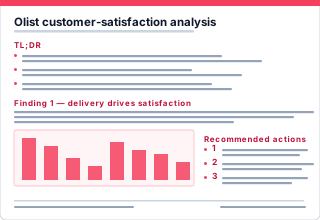
Rubric
You’ll be assessed on the final report (Day 5) against four dimensions, equally weighted:
| Dimension | What we’re looking for |
|---|---|
| Correctness | Numbers reconcile across days. If your SQL says “12% late deliveries” and your dashboard says “18%”, something’s wrong. |
| Clarity | A non-analyst stakeholder should understand your findings without you in the room. Plain English, no jargon. |
| Insight depth | Not just “here are some numbers” — what does it mean? What should the business do about it? |
| Tool use | Did you use each day’s tool appropriately, not just by reflex? E.g., don’t use Python where SQL is cleaner. |
Tips
- Reconcile your numbers across days. If Day 2 (SQL) and Day 3 (Python) give different answers to the same question, find out why before moving on.
- Keep a running notes file. A
notes.mdin this folder is a good place to write down weird things you spot in the data — they often become the most interesting parts of the final report. - Don’t try to answer everything. A focused report on 2–3 concrete findings beats a sprawling tour of the dataset.